hizuri

Mmm.

That's the whole interface. Mumble what you want and it gets done, and nothing you said gets lost on the way.

One window into everything AI can do for you. You talk; your agent does the work on your own machine and shows you what it is doing.

why

AI was supposed to be simple: you say a thing, and the thing exists. Then the internet got to it. Now there are forty models and four hundred tools, and some repo changes everything every Tuesday. Prompt courses go for $499. Every thread that opens with "I built an AI agent that..." ends with a waitlist.

Most people looked at that and decided AI wasn't for them. Fair enough, since nobody built it for them.

We built hizuri for them. You get one window: say what you want, and your agent does it and tells you what it did. Models, tools, keys and setup are the agent's problem, and from you it needs a yes. Ask how any of it works and it walks you through every step. Most people won't ask, which is fine by us.

There's no course and no setup guide, and this page won't say "wow" once.

what it is

hizuri is Claude Code with a voice, a face and a screen of its own. You speak, and it answers aloud, does the work on your machine and puts what it found on a screen in front of you. The assistant is called Zuri until you rename it.

It is a fork of Paseo, the open-source app that runs coding agents on your machine and streams them to your phone, browser and desktop. Everything Paseo does still works here.

what you get

All of it runs today, on your own machine. There is no waitlist to join and no launch thread to read.

Voice, and every phrase on record

Talk with the screen off and the phone in your pocket. Each phrase gets an id, the reply marks which phrases it answers, and a phrase the noise filter dropped stays in the voice journal with the reason. Words stop the reply; a dog barking in the background does not.

Three pages, one swipe

Each agent is three pages side by side: its face, the chat and Show. The assistant moves the app to the page that fits what it is doing, on a phone or in a browser at any width.

Show, the screen it draws on

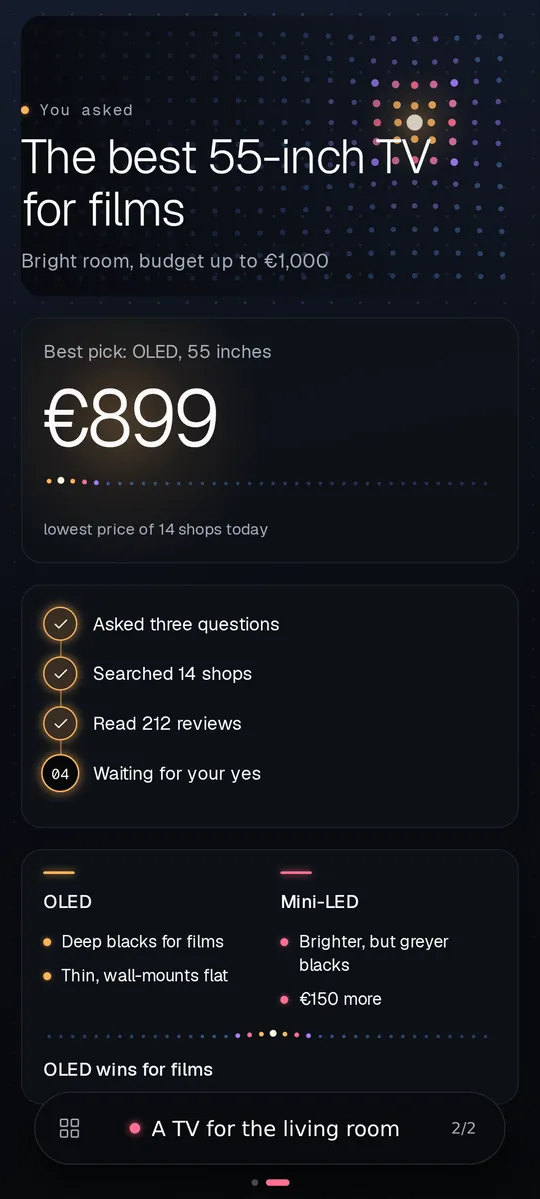
Numbers, tables, charts, steps and choices, filled in while it talks and updated in place. A tab can hold a web page, a picture or a video. A password or a card number goes through a secure form into your vault, and the agent only learns the item's name.

Memory of every session

Every session, typed or spoken, goes into a local memory database. The agent searches it by phrase id or by words, and its rules tell it to look there before it asks you anything.

One folder for the mess agents make

Research notes, drafts, downloads and half-finished trial installs go to ~/hizuri-work/. Your projects stay clean until you say a file belongs there.

Agents that rate tools for each other

Before it installs an MCP tool, the agent reads the reviews other agents left, asks for your yes and runs the tool in a sandbox. Then it writes its own review, backed by a signed receipt of the call.

A face, if you want one

Give it a VRM avatar and it gets a 3D face with lip sync from its own voice, plus body language for listening, thinking, working and speaking. On Android it can float over other apps.

Nothing to configure

The app opens on your last chat. Simple mode shows only the assistant and its settings, and the assistant switches its own model and effort when a task needs it.

Your machine, your data

Agents run on your computer under your own Claude Code login. Files, memory, logs and voice recordings stay there, secrets go to your own vault, and there is no telemetry.

what it looks like

The face page: a 3D avatar standing on a dark background
The face, here with a VRM avatar.
The Show page: a tab titled The best 55-inch TV for films, with the best pick at 899 euros, four steps, and OLED compared with Mini-LED
Show, the screen the assistant draws on (sample data).

install

Send the link to the repo to your coding agent (Claude Code) and ask it to install hizuri. It runs one script from a fresh clone, which you can also run yourself:

git clone https://github.com/andrepurr/hizuri.git && cd hizuri && ./install.sh
  1. The script never uses sudo. It lists one install command for each missing tool and stops; run it again after that. Each step checks before it acts, so a second run is safe.
  2. It starts the memory (one local Postgres container), loads the hizuri plugin into Claude Code, builds and starts the daemon with local voice, and prints how to pair your phone.
  3. Speech runs on the same machine: Parakeet hears you and Kokoro speaks, both downloaded when the daemon first starts.
  4. The Android app builds from source (docs/android.md). After that it updates itself over the air from your own daemon.

where it is going

Next, every service, tool and model goes behind that same window. After that comes a cheap screen anyone can own, showing what your agent does on a server.

The long version is in docs/VISION.md.

built with agents

One engineer builds hizuri by directing AI coding agents, which write the design, the code, the tests and this page. The repo is written for agents as much as for people, and a commit guard refuses secrets and personal data in every commit.

credits and licence

hizuri is built on Paseo by Mohamed Boudra and the Paseo contributors. Both are open source under the Apache License 2.0; see NOTICE.

Type: Geist and Geist Mono by Vercel, under the SIL Open Font License 1.1.